
Here are some tips for managing your home swimming pool and spa.
Installing a public pool or spa?
Let us know by using our Public Pools & Spas Notification Form. Learn more about Development Approval for home or public pools and spas.
Pool
It's important to keep your pool and spa water clean, safe and sparkling to swim in. Disinfection and filtration kill harmful micro-organisms and remove body fats and oils.
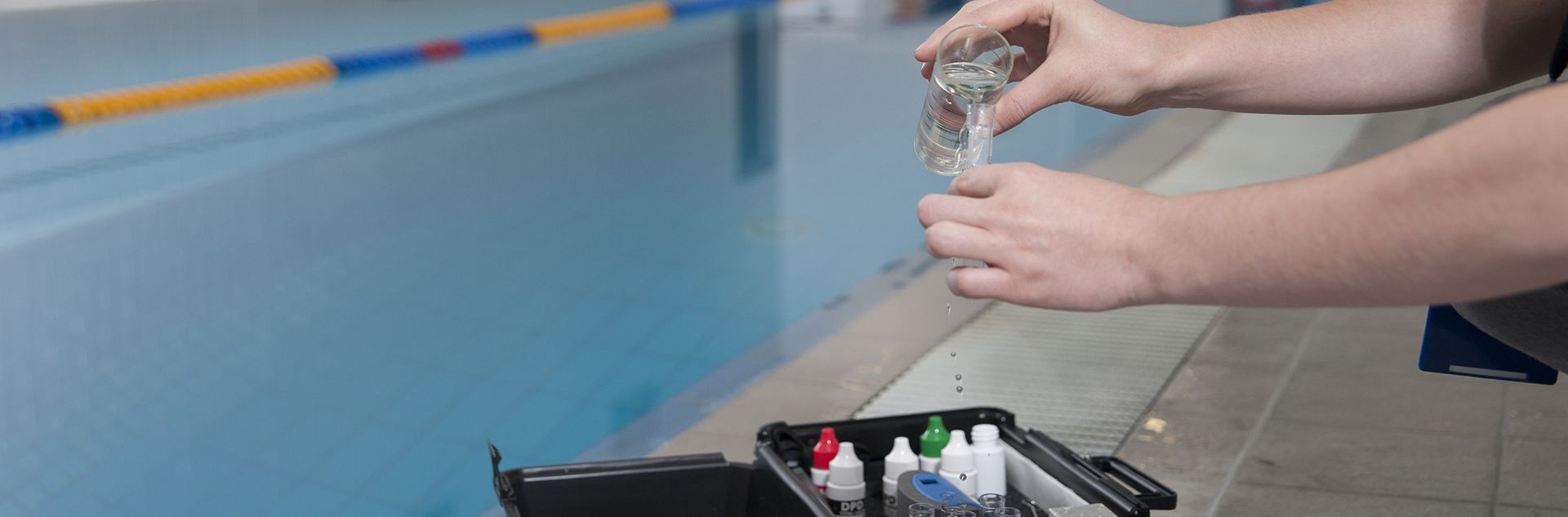
Test your pool water three times a week. It's easy to do this with a reliable pool water test kit. Look for disinfection levels, pH and alkalinity.
Spa
Empty your spa water every one to two months. Or, you can replace 10 to 15% of the water weekly. It all depends on usage.
Always replace spa water if:
- the spa pool is used regularly or by a large number of people, and the disinfectant cannot be adjusted to recommended levels
- algae starts to grow on the surfaces
- the water becomes cloudy and cannot be easily cleaned
It's vital to keep your pool and spa clean to avoid health risks. As well as maintaining clean water, you can take steps to keep your pool clean and tidy.
As part of your regular pool and spa maintenance:
- remove litter
- vacuum the bottom of the pool to remove dirt and debris
- scrub the pool walls and surrounding areas
- clean the pump lint-pot and filter system
- repair damaged pool surfaces
- maintain pipes, filters, motors and electrical equipment
- have regular pool services
- use a pool cover when not in use to keep out dirt and leaves, and minimise water loss by evaporation
Read the manufacturer's instructions and always maintain your pool, as well as relevant chemicals, accordingly.
Failure to maintain your pool may place you in breach of the Environment Protection Water Quality policy.
If you own a swimming pool or spa, you are responsible for its safety. Drowning is the leading accidental cause of death in young children. Most accidents occur in private backyard pools.
All swimming or spa pools must have a continuous safety barrier maintained by the pool owner that restricts access by young children to the pool.
Fencing must be constructed in such a way to make sure that:
- the fence is an effective barrier to young children
- it is permanent
- young children can't crawl under or climb over it by using foot and hand holds
- it is at least 1.2 metres high
Any boundary fences used as part of the child-safety barrier must be at least 1.8 metres high on the side that faces the pool, with a 900 millimetres non-climbable zone at the top inside of the fence. Note that a boundary barrier may be climbable on the neighbour's side.
Gates to the pool area must:
- swing outward from the pool area
- be self-closing from any position
- be fitted with a latching device, out of reach of small children, at least 1.5 metres above ground level
Our Environmental Health Officers maintain the health and safety of our community and environment. They undertake regular inspections all public swimming pools located in our area to test water quality, and the safety of the surrounding facilities.
Swimming pools and spas FAQ
Do I need Development Approval to install a pool or spa?
Yes, Development Approval is required for the installation of any of the following:
- A swimming pool
- A spa which has a maximum capacity exceeding 680 litres
- A wading or paddling pool which is capable of being filled to a depth exceeding 300 mm
- An above ground or inflatable swimming pool which incorporates a filtration system and is capable of being filled to a depth exceeding 300 mm.
Note: All new pools and spas also require a safety fence or barrier that complies with the Building Code of Australia (BCA)
What if I have an existing pool that does not have a safety fence or barrier?
If the pool or spa was approved after 1 July 1993 it must be maintained to the pool safety requirements that were current when the application was lodged.
If the pool or spa was approved before 1 July 1993 as a minimum it must continue to be maintained to comply with the Swimming Pools Safety Act 1972. Unless you intend to sell your property the pool safety barrier must then be upgraded/installed to the current standards before settlement of the property (as per Minister’s Specification SA 76D).
All new safety fence and barriers require Development Approval
What criteria does the safety fence or barrier need to meet?
A safety fence or barrier must be constructed in accordance with the Australian Standard AS 1926.1 which states:
- The height is not less than 1.2 metres
- The clearance between the ground and the bottom of the fence does not exceed 100 mm
- The gap between vertical fence rails does not exceed 100 mm
- Any horizontal fencing components are spaced a minimum of 900 mm apart
- Any boundary fences used as part of the safety fence or barrier must be at least 1.8 metres high on the pool side with a 900 mm non-climbable zone at the top on the pool side of the fencing.
Gates to the pool/spa area must:
- Swing outward from the pool area
- Be self closing and self latching from any position
- Be fitted with a latching device that is out of reach of small children (minimum 1.5 metres above ground level).
Note: In South Australia doors must not provide direct access from the house, garage or outbuilding to a new pool or spa area even if fitted with child resistant door sets.
Can a hard cover on a pool or spa be used as a safety barrier?
No. A safety fence or barrier must be constructed in accordance with the Australian Standard AS 1926.1 as described above.
Will Council inspect my pool, spa or safety barrier?
Yes. As of 1 January 2014 the SA Government legislation has required councils to inspect all new pools and spas including swimming pool barriers for compliance. Inspections are also required for amendments or variations to an original development approval or stamped plans and associated conditions and alternate solutions to existing swimming pools/spas and or safety barriers. Further information regarding inspections and compliance requirements can be found on the PlanSA website.
What information do I need to provide as part of my Development Application?
A Development Application for a pool or spa must be lodged online on PlanSA’s website and include the following:
- A site plan (showing all property boundaries, existing structures, any easements, the location of the proposed pool or spa and all soft landscaping)
- The location and details of the pool safety fence or barrier (with evidence of compliance with AS 1926, which may include Codemark certification or Engineering calculations) including window treatments and latching details for the gate into the pool or spa area. Please note that if the existing boundary fence will act as a safety barrier it will have to meet these requirements also.
- Details of the pump and filtration equipment (including any acoustic treatment, second suction point and method of draining the pool) as per AS 1926.3
- Where the pool filter pump is to be located less than 12 metres away from an adjoining or neighbouring house it must be enclosed within an acoustically specified enclosure to comply with EPA guidelines.
- Manufacturer/Engineer’s design details, including elevations and calculations for the proposed pool or spa.